News · 9 November 2026
His well reads above 25,000 ppm.
His papaya trees need under 450 ppm.
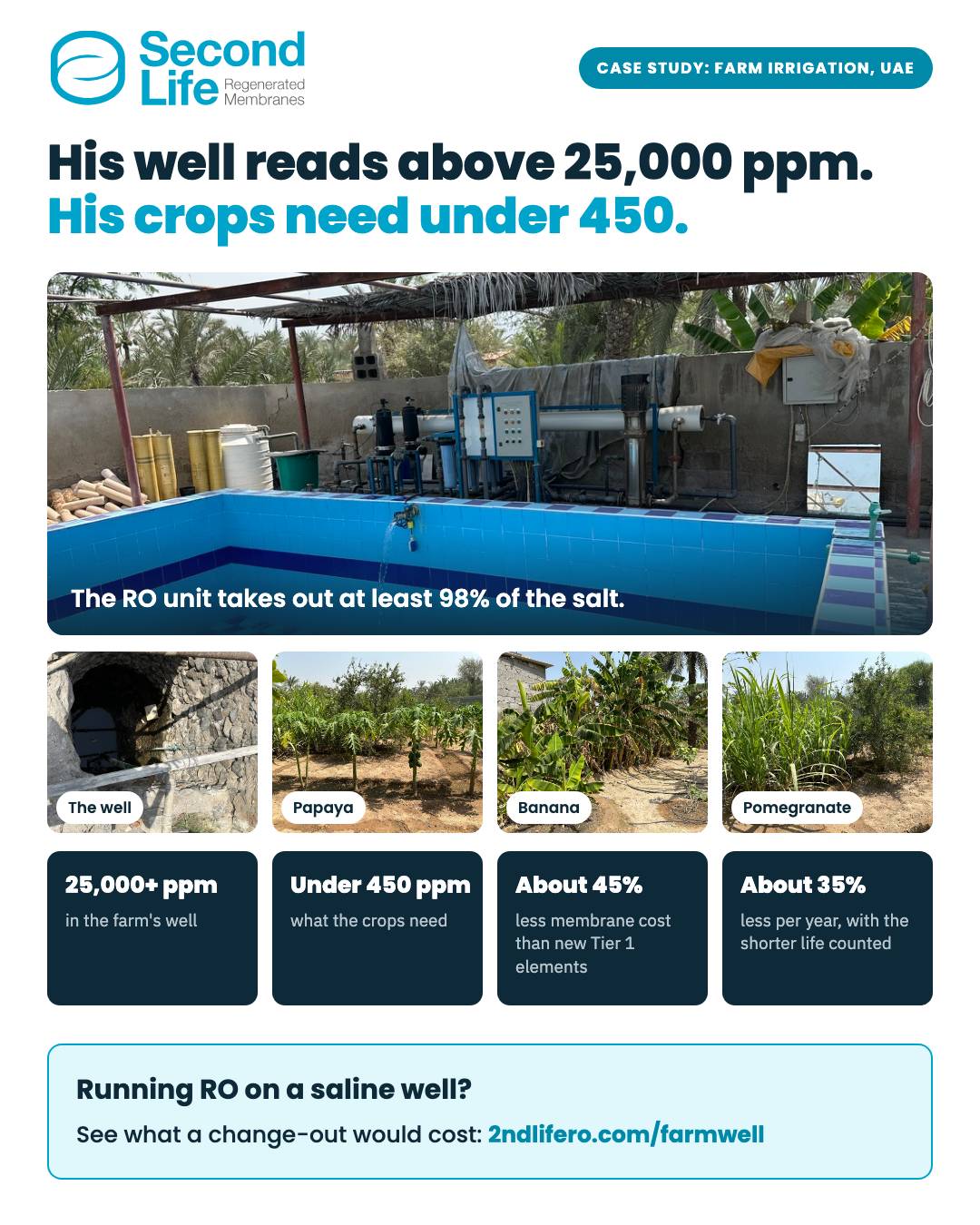
It's a small farm in Ras Al Khaimah.
Seawater sits at about 35,000 ppm, so this well isn't far off.
FAO's irrigation guide puts severe restriction above 2,000 ppm.
Under 450, it sets no restriction.
Most woody fruit crops are salt sensitive, and salt builds up in the soil between waterings.
So the RO unit in the photo has to take out at least 98% of the salt.
He ran it on new Tier 1 elements.
Then he moved to our Super High Rejection grade.
It starts as a spent seawater element, goes through our own regeneration process, and gets tested on its own to ISO 20466.
The water stayed under 450 ppm.
His membrane cost fell by about 45%.
There's a limit on his farm too.
Our elements last about 85% as long as new ones there.
So we ran the sum per year of service.
Once the shorter life is counted, he still spends about 35% less on membranes.
Crops don't pay extra for water cleaner than they need.
And if your duty needs every point of seawater rejection, at full spec, buy new.
We'll tell you so.
Running RO on a saline well? See what a change-out would cost: 2ndlifero.com/farmwell
First posted on our LinkedIn page.